
Withstand Voltage & Insulation Reliability: AC
Withstand Voltage & Insulation Reliability: AC-DC Adapter Purchase Verification
Publication Date:2026-11-6
By:Shenzhen Simsukian Electronics Technology Co., Ltd
Abstract
Insulation defects are one of the top causes of customs detention and product recalls for external AC-DC adapters shipped to EU, UK, Korea and North America markets. Dielectric withstand testing, creepage distance and insulation material performance form the core of safety assessment. Rigorous aging and immunity testing are essential to prevent equipment shutdown and electric shock hazards.Simsukian maintains a full reliability verification system to deliver practical insulation safety evaluation guidance for overseas OEM buyers.
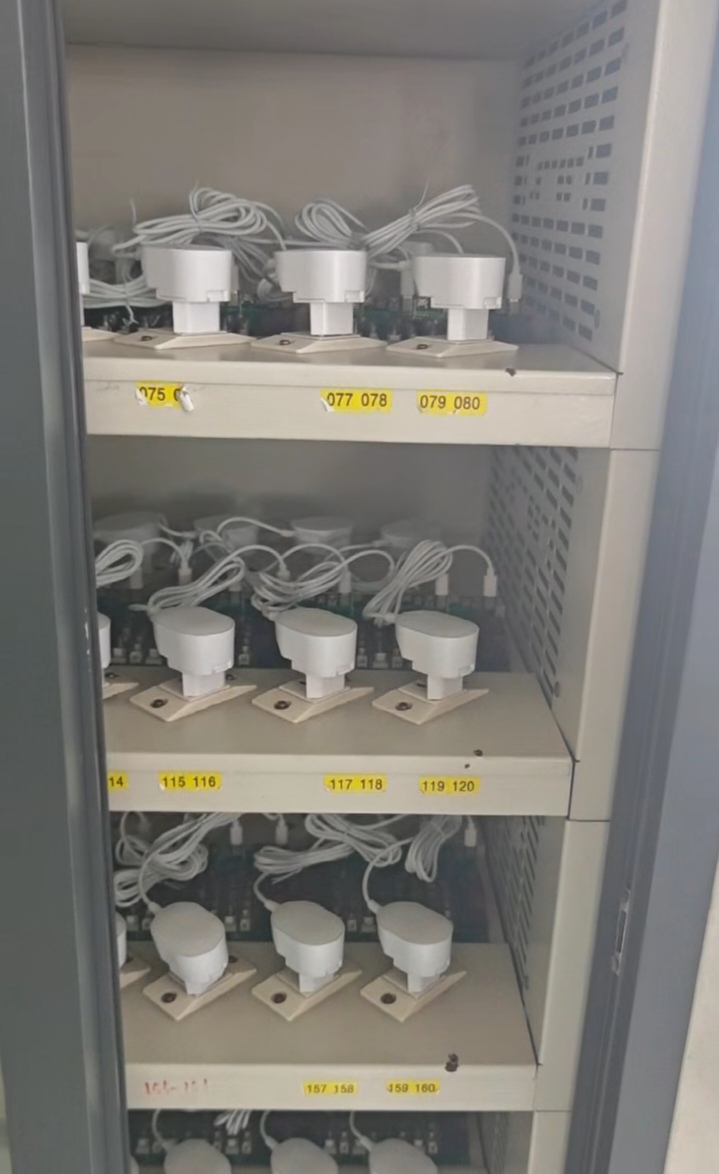
Burn-in Test
Insulation Class and Dielectric Withstand Test Baseline
Class II AC-DC adapters rely entirely on insulation structures for protection without protective earth connection. Therefore, dielectric withstand voltage testing is a mandatory production control item. The standard production test appliesAC 3000Vfor 60 seconds; the unit passes if no breakdown or flashover occurs.
A key insulation metric is the isolation resistance between primary and secondary circuits, which should reach ≥100 MΩ under normal conditions. Creepage distance (the shortest path along the insulation surface between live parts and enclosure) and clearance (the shortest air gap between live parts and enclosure) must comply with IEC 62368-1[1]. Many procurement disputes arise when samples pass testing, but PCB or housing modifications in mass production reduce clearance margins.
|
Industry quote: “Many procurement teams only verify sample reports and ignore creepage distance degradation caused by mass-production version changes, which is the top trigger for compliance recalls of power adapters in cross-border shipments.” — Independent Power Electronics Compliance Consultant |
Common Root Causes of Insulation Failure in Mass Production
Insulation failure rarely comes from raw material defects alone. It usually stems from process control gaps.
First, flux residue or solder beads on the PCB create leakage paths under humid conditions and reduce withstand voltage margin. Industry statistics show insulation failures caused by flux residue in humid environments account for 32% of field adapter faults.
Second, poor selection of plastic housing and isolation gaskets leads to insulation degradation under sustained high temperature.
Third, inconsistent wire stripping allows exposed primary conductors to sit too close to secondary circuits.
Fourth, BOM changes are implemented without full re-testing of safety structures, with only electrical parameters checked.
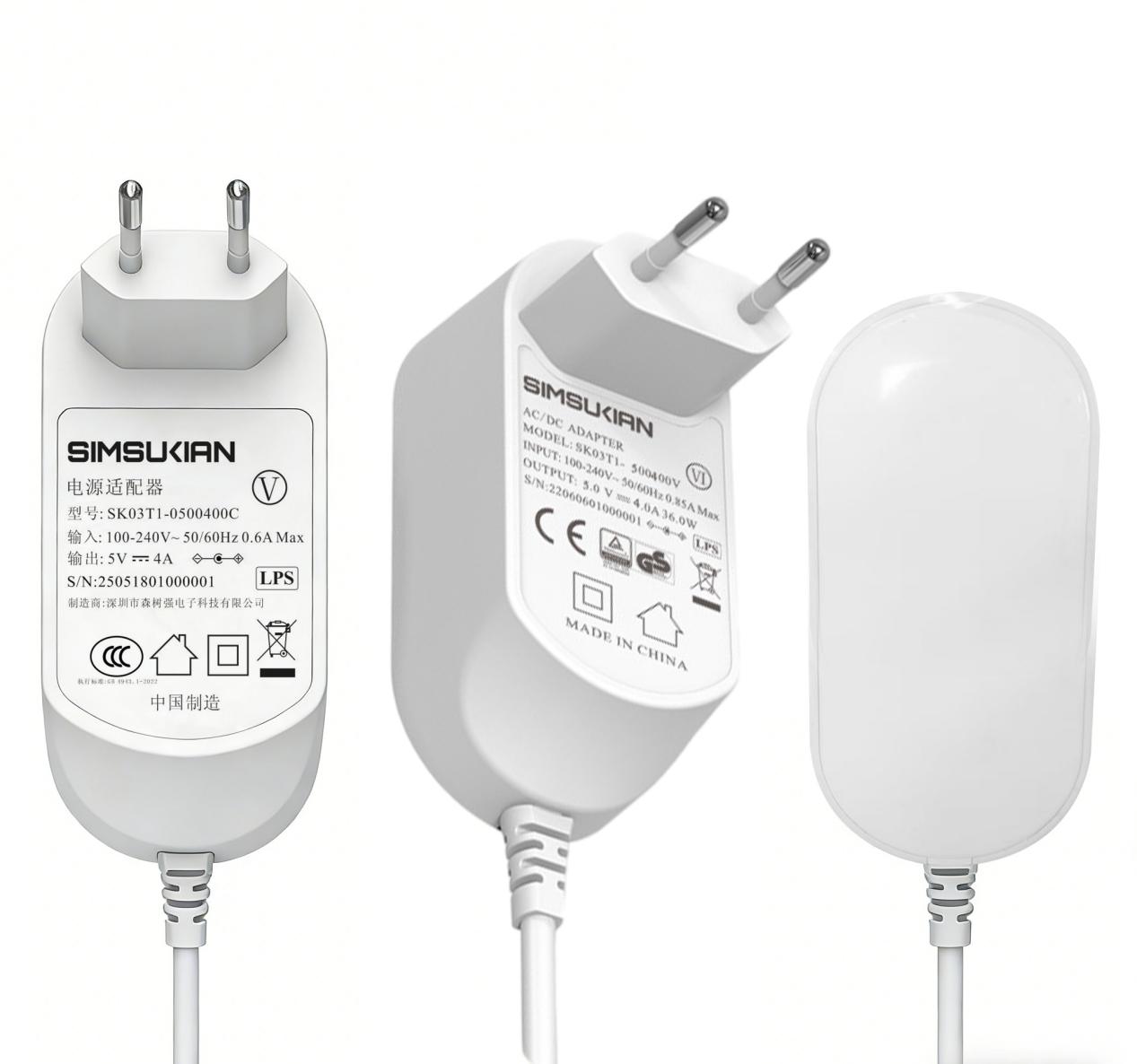
Wall Plug-in Power Adapter with KR Plug Pin
Buyer’s Checklist for Insulation Verification
Request raw dielectric test reports for the exact model, not just certification cover pages.
Confirm the certified hardware version matches the version being shipped.
Sample units for dielectric testing after humidity conditioning to simulate high-humidity overseas environments.
Review datasheets for isolation gaskets, bobbins and cables to verify temperature rating and insulation class.
Confirm automatic hipot testers are deployed on the production line for 100% in-line screening.
Certificates alone cannot guarantee consistent insulation performance. Ongoing in-line testing, batch sampling and formal change control are required for stable long-term supply. Many overseas buyers focus only on voltage and current specs and overlook insulation structure checks, which may lead to costly recalls.
Conclusion
Dielectric strength and insulation are fundamental safety requirements for power adapters and are heavily audited during certification, customs inspection and market surveillance. Buyers should move beyond collecting certificates and build an end-to-end verification workflow covering drawings, material specs, production testing and batch re-verification, to identify hidden risks such as insulation ageing, insufficient clearance and process contamination before cross-border shipment.
Shenzhen Simsukian Electronics Technology Co., Ltd.
Shenzhen Simsukian Electronics Technology Co., Ltd. specializes in the R&D and manufacturing of AC-DC power adapters. It operates an in-house safety and reliability laboratory capable of dielectric withstand, insulation, temperature rise and EMC immunity testing. Its products hold CE, CB, GS, BS, UL, CUL, FCC, NOM, PSE, KC, CCC, SAA, ERP, CEC, DOE, MEPS approvals for global markets. The company supports custom insulation structure design and pre-certification review for different export destinations, delivering compliant power supplies for OEM customers in lighting, industrial equipment and consumer electronics sectors.
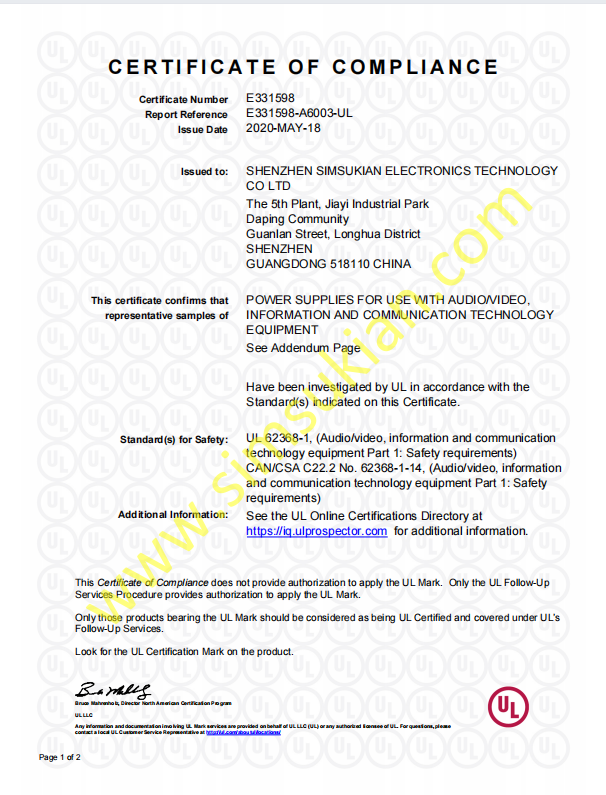
UL Certification Certificate
FAQ
Q: How is the ESD performance of Simsukian adapters? What KV level can it pass?
A: Simsukian adapters support ESD contact discharge ±8KV, air discharge ±15KV, with dedicated ESD protection design.
Q: What is the surge protection rating of Simsukian adapters? Can it work stably in areas with old power grids?
A: Standard versions support differential mode (line-neutral) ±1KVand common mode (line/neutral to earth) ±2KV. Higher surge ratings can be upgraded for mountainous regions and aged power grids.
Q: What standards does Simsukian follow for temperature rise? Will it trigger protection falsely under long-term full load?
A: It complies withGB4943, IEC62368safety standards. The case temperature limit is75℃. False protection will not occur under rated load.
Q: What is the flame retardant rating of Simsukian adapter housing? Is the material fire-resistant?
A: The housing adoptsV0grade flame-retardant PC material. It self-extinguishes once the open flame is removed.
Q: Do Simsukian adapters have OVP, OCP, SCP and OTP protection?
A: Simsukian adapters come with full four-level protection: Over VoltageOVP, Over CurrentOCP, Short CircuitSCP, Over TemperatureOTP.
References
[1] IEC 62368-1:2018, Audio/video, information and communication technology equipment – Part 1: Safety requirements
[2]Simsukian official website
[3] UL Certificate Inquiry Platform
[4] KC Certificate Search Platform